
This portfolio is a gallery of design projects I've worked on at Stanford. This is not a graphic design portfolio; rather, the projects were focused on interaction design, understanding user needs, and learning the design process.

My group looked at organizing meetings between friends on a smartphone like the Nokia N95. Our prototyped app let users creating events quickly and locate their friends on a map. Our process covered user observation, storyboarding, paper prototyping, and prototype testing with users. The functional prototype was written in Flash Lite.


For another group project, my group created a paint program using the Nintendo Wii remote (the "wiimote"). Our concept was to mimic abstract art like Jackson Pollock. While we talk about getting the right design being more important than getting the design right, when designing for subtle handheld gestures, it's very important to get the details of feel and response right. Also, it's good to know the device you're working with well. We tried to use the accelerometers and the 2D camera at the same time, but when the user waved the Wiimote around to paint, we couldn't get any good camera data.

Design for Agile Aging was a two-quarter class offered through the Stanford d.school. We were asked to find ways to maintain mobility in older adults. This turned out to be an interesting class because we had to learn about a user population that was very different from ourselves. My group was called the "Elegant Safety" group. After interviewing and visiting some older adults and younger people with disabilities, we focused on a support system to help people get on and off the toilet. It incorporated storage space and support arms that could be hidden. Our prototype was built out of Ikea furniture pieces.
During the second quarter of Agile Aging, we started from a different group's project. We looked at maintaining mobility through activity and at connecting people who might otherwise be isolated. The final result was the video prototype above, showing a system that allows families to connect online and dance together. Individuals could also use it to perform exercise routines.
This was another interesting project because the challenges were cultural rather than technical. We used off-the-shelf video chatting software to handle the communication. The real work we did was visiting families and older adults so they could try the prototype and we could see their responses.
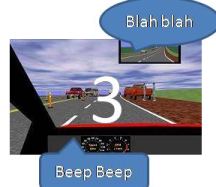
My partner and I examined how drivers' attention could be gotten when they are talking on a cell phone. Our hope was that this would give us insight into how paying attention works when talking on a phone and driving, and research of this type could eventually lead to safer driving environments. Our conclusions are written up in a paper.
I am currently enrolled in an HCI in Music class, where my group will be creating a physical musical interaction, and a Graphics class.